Driver Education
Defensive driving for teens: How to teach safe driving habits
Learn how to teach defensive driving for teens, from hazard recognition to speed management, and how intelligent speed assistance (ISA) can reinforce safe habits.

See how LifeSafer ISA protects your teen’s safety and your peace of mind with our cutting-edge speed limiting technology.
Key takeaways:
- Defensive driving means staying alert, anticipating other drivers, and adjusting speed before a situation becomes dangerous.
- Speed is a top risk for teens. Drivers ages 16-19 have nearly three times the fatal crash rate per mile of drivers 20 and older.
- Parents can build habits by teaching one skill per drive and debriefing after each one. An ISA device helps reinforce safe, legal driving speeds when a parent isn’t in the car.
Handing the car keys to your teenager for the first time can be both exciting and scary. Every parent wants reassurance that their teen driver knows how to make smart decisions when they are on the road alone.
The good news is that safe driving isn’t just about passing a road test. It’s about building habits that last.
This guide explains how to teach a teenager to drive defensively, and how intelligent speed assistance can reinforce safe driving habits in real time.
Why speed management is a key part of defensive driving
Every new driver makes mistakes. The goal is to reduce the chances that those mistakes lead to a serious crash.
Speeding remains one of the biggest risk factors for teen drivers because it reduces reaction time and increases stopping distance.
- Drivers ages 16-19 have nearly three times the fatal crash rate per mile driven compared to drivers ages 20 and older.
Safe, defensive driving isn’t about getting somewhere faster; it’s about giving yourself enough time to react when conditions change.
What is defensive driving?
Defensive driving for teens means staying alert, anticipating what others might do, and adjusting before a situation becomes dangerous.
Defensive drivers continuously:
- Scan the road ahead
- Maintain a safe following distance
- Watch for pedestrians and cyclists
- Adjust speed to changing conditions
- Leave themselves enough time and space to respond safely
For teens, that habit is the foundation of confident, independent driving.
Defensive driving skills every teen should master
Parents often wonder what to practice during a driving session. Rather than covering everything at once, focus on one skill at a time:
Hazard Recognition
Helping teens anticipate hazards builds awareness long before reactions are needed.
- Encourage your teen to keep their eyes moving instead of focusing only on the vehicle directly ahead.
- Practice spotting pedestrians near crosswalks, cars waiting to turn, brake lights several vehicles up, cyclists entering traffic, and changing road conditions.
- Ask questions like "What do think that driver might do next?" And “do you see anyone who could enter the roadway?”
Emergency Braking and Collision Avoidance
Building familiarity with hard braking in a low-pressure setting makes it easier to react when it counts for real.
- Many inexperienced drivers either slam the brakes or freeze during an emergency. Find an empty parking lot where your teen can practice firm, controlled braking and feel how the vehicle responds.
Managing Distractions
Set expectations before every trip: phones away, distractions limited, full attention on driving.
- Phones are a major distraction, but they're not the only ones. Friends, loud music, navigation, eating, and conversation all pull attention off the road.
Speed Management
Learning to drive at an appropriate speed is more than following the posted limit. It means slowing down for rain, traffic, construction zones, school areas, and limited visibility.
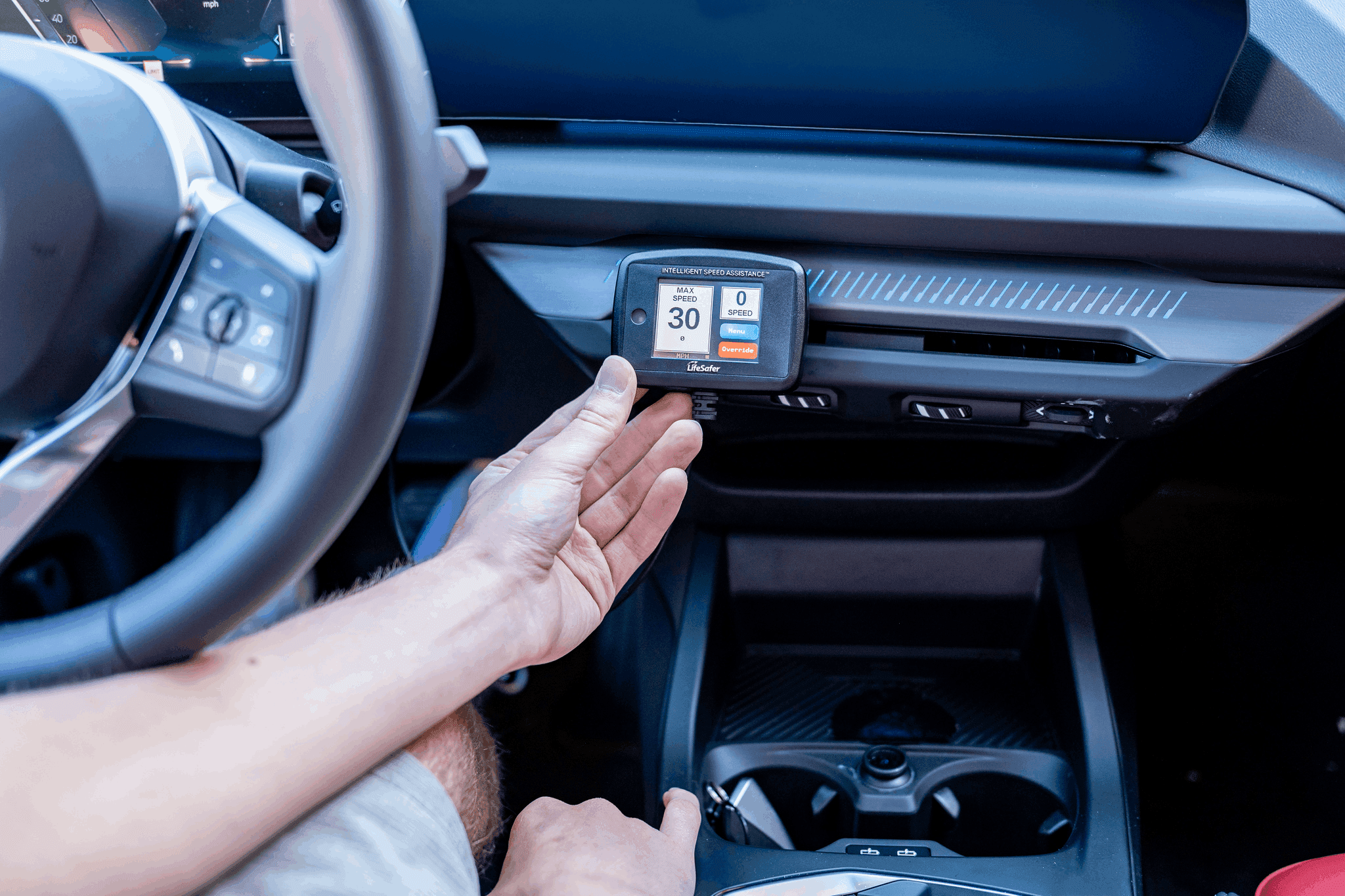
- Intelligent Speed Assistance (ISA) devices use real-time GPS speed limit data to help drivers stay within posted speed limits and build safe driving habits.
- ISA devices don't replace instruction; however, they ensure speed compliance every time a teen is on the road, not just when a parent happens to be riding along.
A practical approach to teaching a teenager how to drive
Confidence builds one lesson at a time. You can't prepare a teen for every situation in a single weekend. Focus on one new skill at a time and gradually introduce more challenging situations.
1. Start in low-traffic environments
Begin in empty parking lots or quiet neighborhoods where your teen can focus on smooth acceleration, braking, turning, and parking without feeling overwhelmed.
As confidence grows, gradually introduce:
- Busier roads
- Highway driving
- Night driving
- Rainy weather
- Heavy traffic
2. Narrate your own driving
One of the most effective lessons happens when you're behind the wheel. Talk through what you're seeing and deciding:
- "That driver is slowing down, so I'm easing off the accelerator."
- "I'm slowing down because I see children near the crosswalk."
- "I'm increasing my following distance because it’s raining."
Hearing your thought process shows teens that experienced drivers are constantly scanning and adjusting, not just reacting.
3. Introduce one new skill per practice drive
Trying to teach merging, parking, lane changes, and defensive scanning in one session gets overwhelming fast.
- Pick one focus per drive: following distance one day, reading traffic signs the next.
Short, focused sessions tend to stick better than long drives packed with new information.
4. Debrief after every drive
Instead of pointing out mistakes right away, ask open-ended questions:
- "What was the most challenging part of today's drive?"
- "Did anything surprise you?"
- "Is there anything you would handle differently next time?"
These conversations help teens become more confident, thoughtful drivers.
5. How technology can help reinforce safe habits
No device replaces engaged parenting or real-world practice. But once your teen starts driving independently, tools that reinforce what you've already taught can carry real weight.
For a lot of parents, speed is the biggest worry, since it raises both the odds and severity of a crash.
- LifeSafer's Intelligent Speed Assistance (ISA) is designed to act as a speed safety net, helping reinforce the habits teens learned during supervised practice. ISA uses GPS and real-time speed data to help teen drivers maintain safe, legal speeds while allowing them to focus on building confidence behind the wheel.
For parents, it provides added peace of mind during one of the most challenging stages of learning to drive.
Give your teen a safer start with LifeSafer ISA
Building safe driving habits takes time, practice, honest conversation, and chances to learn from experience.
Explore the LifeSafer ISA new driver program, built to complement the guidance parents already give, not replace it. It's an aftermarket device, professionally installed and removed once it’s not longer needed.
Contact LifeSafer ISA today and give your teen a head start on defensive driving habits that can help your new driver build safer habits for life.